
New podcast out
Hey everyone!
Two related bits of news today:
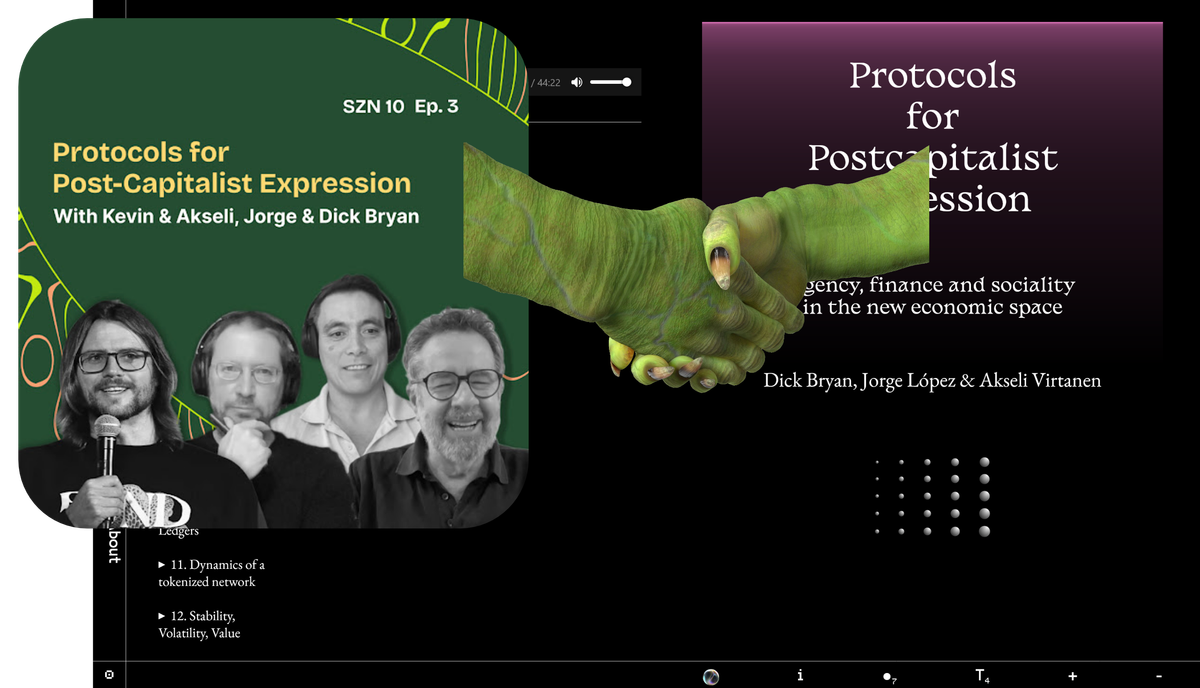
1️⃣ ECSA × Kevin Owocki podcast is out
Our conversation with Gitcoin co-founder Kevin Owocki on the GreenPill podcast is out. If econ + coordination + code = your jam, this one’s for you. Listen with your preferred tooling and let us know what you think!
 Pocket Casts
“I really, really, really liked this book … It was one of the few books that I’ve read that is very specific and has a systems level architecture for what this economy is going to look like … I want to work together with this community.”
– Kevin Owocki, Gitcoin co-founder, GreenPill Network
Pocket Casts Overcast Podlink Apple Spotify YouTube

2️⃣ Postcapitalist publishing?
Publishing a postcapitalist book should not stop at its content, but extend to the material form of the book itself and into its economics. But how do you do that? How do we move from a static commodity made to be sold to a living, evolving public good and a network that is economically sustainable?
While working on the content of the book, we were exploring these questions at the same time. As a result, Protocols for Postcapitalist Expression became a unique, open-access digital experience that actively recodes what a “book,” “open access” and “economics of open access publishing” can be. It is now live here:
Some of its features that turn publishing into a collective economic performance where value, liquidity and meaning emerge from participation:
- Accessibility and deep text navigation — The book is made as open and accessible as possible, being offered as HTML, PDF and EPUB text and in an audio version. Dynamic contextual footnotes, fine-grained deep links down to the paragraph level, and a glossary overlay make for a greatly enriched experience of both reading and sharing.
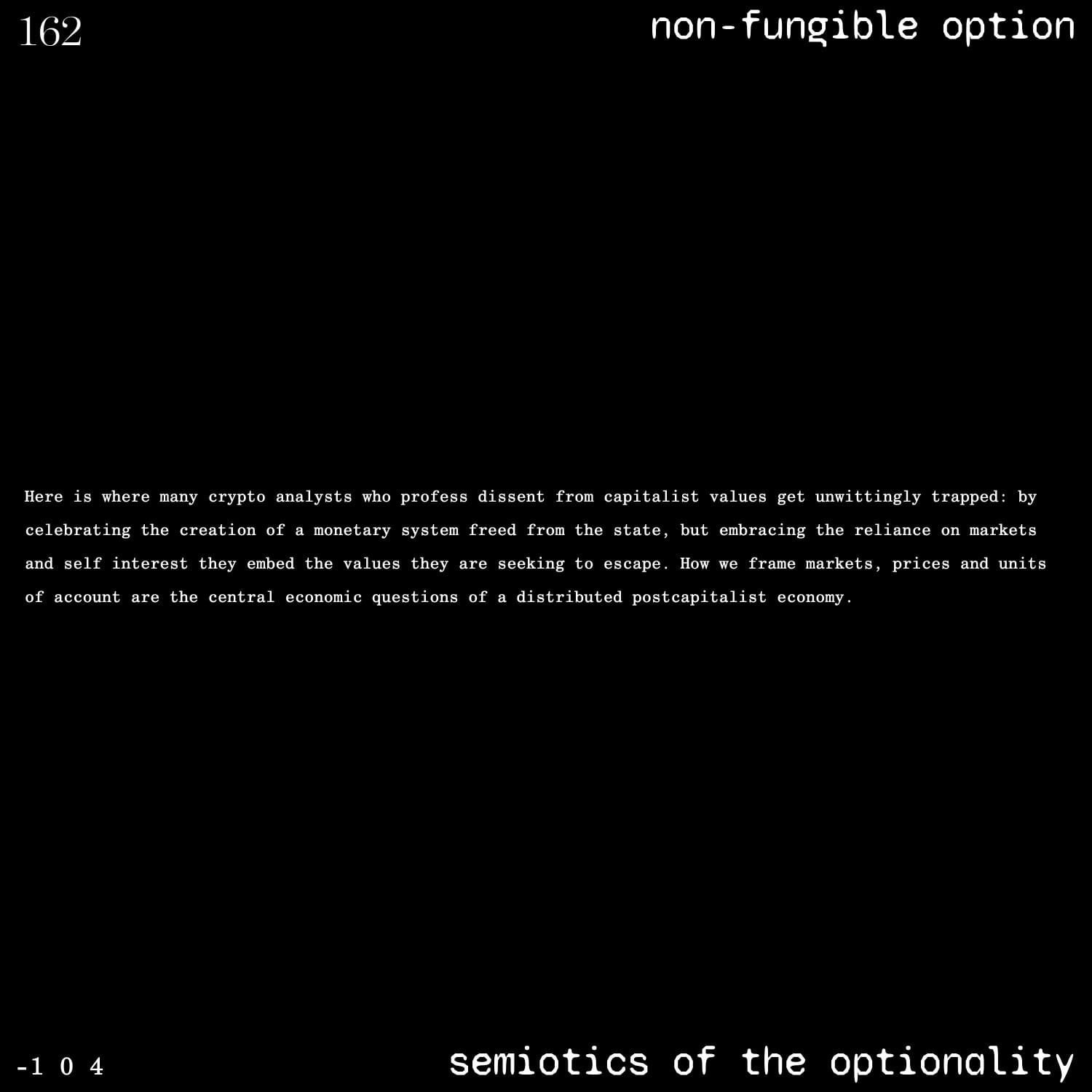
- Economic media mode and community building mechanisms — Each of the book’s paragraphs is a unit of discourse – a human- and machine-readable textual expression unit that also embeds relational rights. Each of these 601 units can be collected as an NFT. By collecting, readers effectively become co-publishers who gradually “unlock” the book into open access.
Collectors also gain a number of rights — access to the ECSA token whitelist, co‑publisher credit and a unique generative-cover PDF — that enable a living organization to grow from the soil of the book. - Co-Publishing and the Peer Production License — The publishing code template CoPu (Co-Publishing) was developed by Pablo Somonte Ruano as free software that can be forked by anyone to publish their long-form texts in a similar format. To prevent commercial exploitation and keep its performance aligned with postcapitalist principles, CoPu is licensed under the terms of the Peer Production License (PPL) that allow only non-profits, cooperatives, and other “commoners” to reuse the software.
- Different pathways of meaning — Each unit embeds metadata which transform the book from a linear text into different tracks, webs, or volumes of meaning — a networked topology that can be navigated in multiple ways. Metadata include the unit’s linear index; a three-dimensional coordinate set placing it in the volumetric space of expressions; and a semantic node composed from randomly paired key terms, which afford unit-to-unit connections based in optional semantic differentials rather than one sequential hierarchy. Different semantic computations — just like different economic computations.
Check out Pablo explaining What is co-publishing? and head over to postcapitalist.agency to try the features out yourself!
🍷 Enjoy,
ECSA disculturailleurs