
What if the economy is a medium?
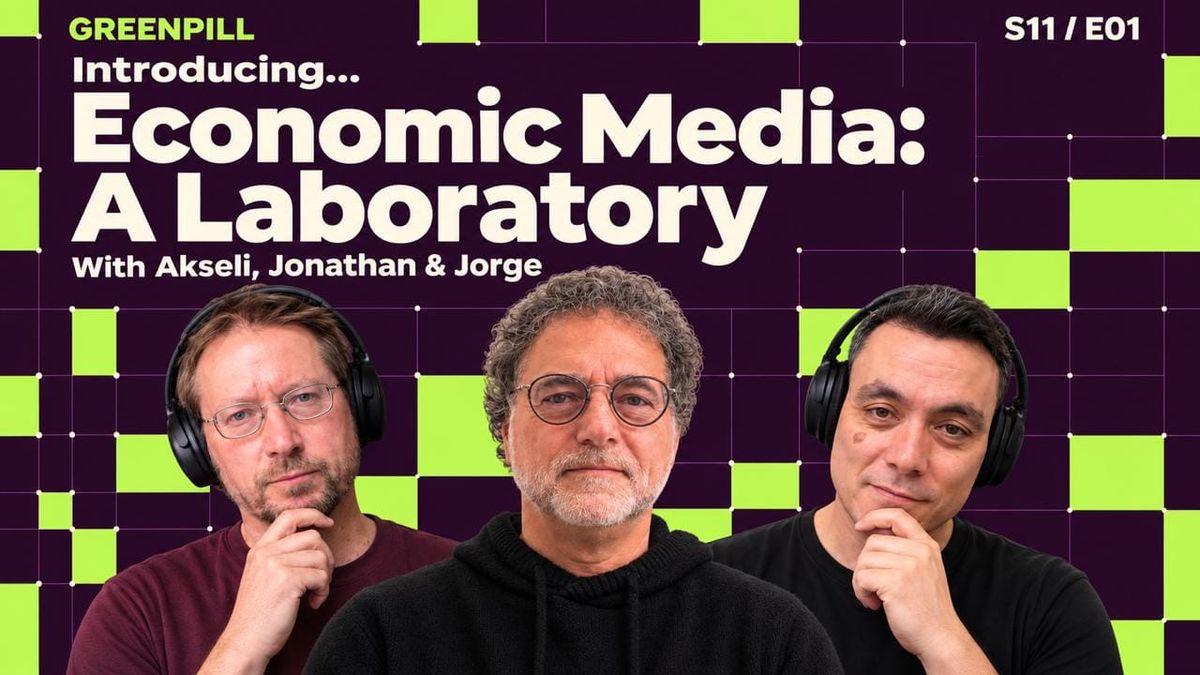
- Episode 1 of the Economic Media: A Laboratory -podcast series is out: “Introducing the Laboratory: What If the Economy Is a Medium?”
- Last week we wrote that AI has arrived at our problem. This podcast series asks the question underneath: if economic coordination now runs through protocols, ledgers and agents, what kind of medium is the economy becoming, and who gets to write in it?
- It is a laboratory, not a regular talk show. Thinkers and builders from distributed systems, accounting, anthropology, computation, politics, media theory, law and art bring their own models for coordinating, and let them meet, clash and change.
- Every episode leaves a record: Field notes with primitives, tensions and open problems, available at our website.
- A new episode every other week. On Greenpill.
Dear friends and collaborators,
A short letter with a bit to listen to.
Last week we wrote that AI has arrived at our problem. In the first episode of Economic Media: A Laboratory, our new podcast sub-series on GreenPill, Jonathan Beller, Jorge López and Akseli Virtanen go one layer deeper. We have ever more capable computational networks, models and connectivity. Yet, as Akseli puts it in the episode, while artificial intelligence keeps growing, “our economic intelligence is getting nowhere.” Why?
The episode’s wager is that the economy is a medium. Writing, numbers, ledgers and money never simply represented economic life. They made some forms of coordination possible and excluded others. Today protocols, ledgers, contracts and agents are becoming a new inscription layer for economic life. They shape what can be counted, who can act, how obligations last, and what a network recognizes as value. In the episode Jorge gives the protocol definition of agency: “the capacity to enact changes in the network." So the questions become: which changes, of what kind, and who has access to them?
Why a laboratory?
The transformation sits between many disciplines, and none of them captures it whole. We do not yet have shared concepts for it. So, as Xerox PARC once did for the computer, we are bringing people from very different fields into one room to learn the new medium together: how we interface with it, what it can express, and how to become literate in it.
Guests are invited to lay out their own model of coordination, without having to adopt our vocabulary. Disagreement is not a failure mode. It is the signal that something new is being explored, and you can hear it already in episode 1. Jonathan resists the episode’s own thesis: the economy, he argues, is not one medium but an ecology of media, so changing it means intervening in the ecology rather than inventing a new medium. We keep that disagreement in, because the meaning and value of the laboratory emerges from mining such differences.
The season braids domains instead of grouping them. A conversation on distributed systems is followed by one on accounting, then media theory, then anthropology, before it returns, changed by what came in between.
After each episode we publish field notes: three primitives (concepts the guest treated as foundational), two tensions (things that do not quite fit together with our earlier episodes) and one open problem. Over the season they add up: concepts that recur, tensions that remain unresolved, questions that refuse to disappear. The archive becomes a shared reference point – not a doctrine, but a map of an emerging field of economic media.
The series is made together with Kevin Owocki and Greenpill, a home for regenerative coordination and public goods. Guests include, among others, Michael Power (Professor of Accounting at LSE, author of The Economy of Traces), Bill Maurer (Professor of Anthropology at UC Irvine), Hito Steyerl (filmmaker, Professor for Emergent Digital Media at Munich Art Academy), Mireille Hildebrandt (lawyer, philosopher, Professor of Law and Technology at Radboud University), Leif Weatherby (Professor of German at NYU, author of Language Machines) and more.
The lab is open
- Episode 1 on the Greenpill Podcast wherever you listen, and on YouTube.
- Field notes and more on our website.
- Kevin Owocki’s announcement with timestamps.
If something sparks a thought, a disagreement or an idea for a guest, write us at hello@ecsa.io.
The lab is open. See you there!
Thank you Kevin Owocki and Greenpill for hosting the series, Daniel Shinbaum for production and Pablo Somonte Ruano for the visuals.